
Grant County Police Blotter Sources
The Grant County Sheriff publishes no verified 72-hour arrest log or weekly booking table. Nothing complete sits online. The press-release page reaches into prior years, but it holds selected announcements on mixed topics. Marion, Gas City, and Upland offer no arrest feed. That gap does not mean records are missing. It means the custodian, date, and record type must be pinned down first.
Start with official agency records. A police report documents the agency event, a jail record covers intake and custody, and a court docket shows filed charges and the outcome. News stories and secondary booking sites can help locate a date or agency, but neither is a complete official blotter. They may keep an entry online long after release.
Read Grant County Arrest Entries
Work backward from the sharpest fact you have. Names alone invite false matches. A booking date, arresting agency, or case number narrows the record fast. Treat any website date as a clue until an official record shows whether it marks the arrest, jail receipt, publication, or court filing.
- Start with the Sheriff’s official site or the named city police agency. Look for the original announcement or request the dated incident record.
- Compare the arrest date with the jail-received date and any release or transfer time. Those fields explain many apparent gaps.
- Search Indiana MyCase by case number when one is known. Otherwise use the party name and check the correct Grant court.
- For an older entry, send a focused APRA request naming the person, date range, arresting agency, and exact record sought.
The Grant County Sheriff press-release archive shows the county’s selected announcement format:
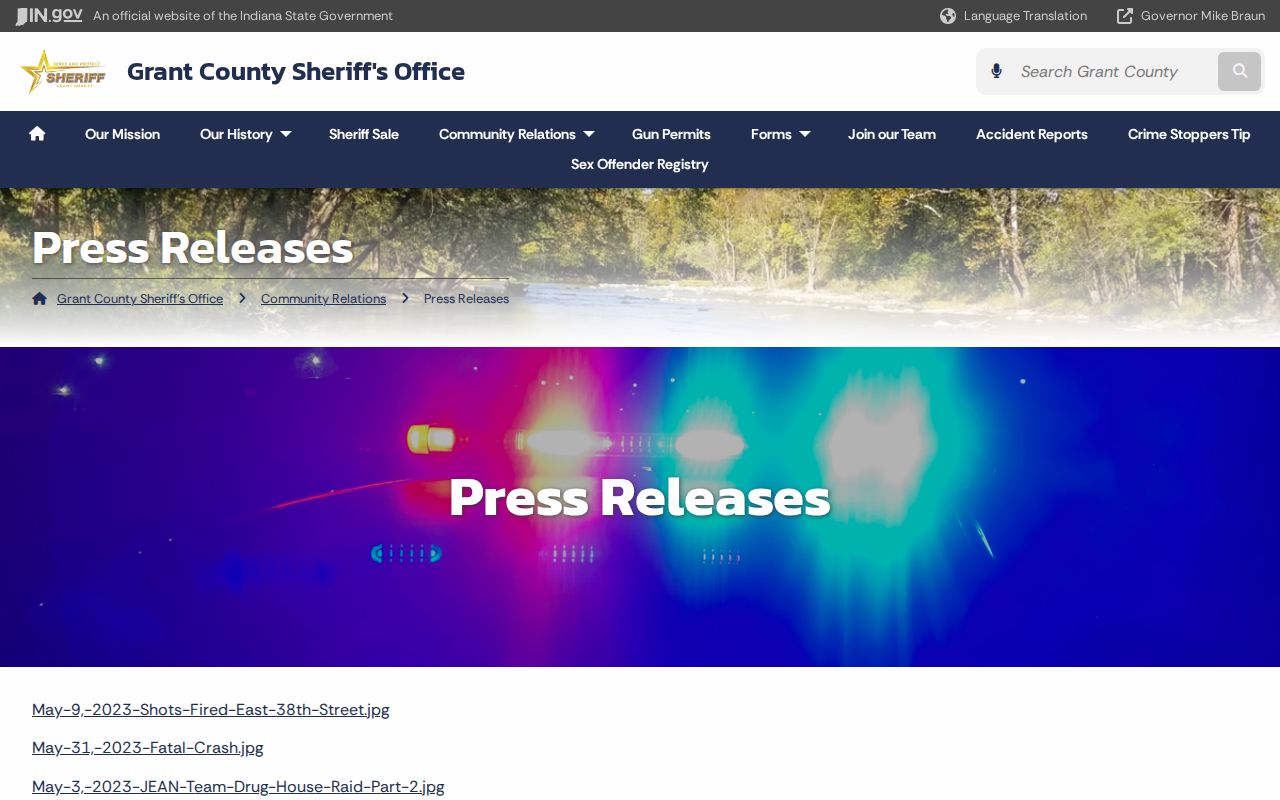
Dated image posts can confirm a specific public announcement. The archive makes no claim of listing every arrest.
Grant County Arrest Log Fields
The official Grant portal exposes no public result fields. Indiana APRA guidance offers the safer baseline for an agency request. Secondary pages can show more detail. Label those extra fields unofficial, never blend them into the county record.
| Entry field | How to interpret it |
|---|---|
| Name and age | Identity data in an arrest or jail record; confirm the correct person. |
| Arrest circumstances | Time, place, agency, officer, and alleged basis, subject to lawful limits. |
| Jail-received time | Intake time, which may follow the arrest time. |
| Charge | The charge recorded at that stage. |
| Bail or bond | An amount if fixed; it does not establish release or guilt. |
| Discharge or transfer | Shows when county custody changed. |
| Photograph | Grant County’s official public-display policy was not verified. |
Arrests.org, Busted Newspaper, and Mugshots.com each use their own filters, labels, and page dates. None follows county field definitions. A court date or case number belongs in MyCase. A photo shows a past booking moment, not current custody.
Grant Weekend Arrest Timing
The county does not say whether public data are entered continuously, in batches, or through an office workflow. Jail intake can happen outside Sheriff administration hours. Every system runs on its own clock. The arresting agency, jail, VINE, news desk, court, and secondary website each move at a different pace. A Friday arrest might reach the jail that night, appear in a notification system later, and hit a court docket on yet another day. Holidays stretch the gap.
Never force several dates into one booking date. A late article does not mean it just happened. Same-day events call for a different tool. Use the Arrests Last 24 Hours verification path for anything still in processing. The multi-day approach is for tracing and reconciling records, not checking a live cell assignment.
Grant Arrest News Is Selective
The Chronicle-Tribune is Grant County's local daily. Indiana's official newspaper list describes it as appearing five times per week. Its crime coverage is story-driven, not a verified booking gallery. WRTV keeps a Grant County news section. 21Alive has reported individual events based on Sheriff information, while publication depends on news value and editorial timing rather than jail intake sequence. The Chronicle-Tribune homepage provides local publication context:
News captures help locate reported events. They are not a county custody list. A 21Alive report about a Marion pursuit draws that line clearly. The story covers one event. It names its source agency, not every person booked that weekend.
Note: News photos may be agency or story images and should not be treated as the jail's official booking photograph.
Unofficial Grant Arrest Archives
Secondary pages offer different windows on Grant County arrests. None equals an official county log. Busted Newspaper uses pagination and booking-style entries, while Mugshots.com leans archival with date and city filters. Arrests.org offers daily pages and agency filters. Its Grant pages have shown April dates sitting beside a "Yesterday Bookings" label. That mismatch is a clear staleness warning.
Treat those dated pages as discovery tools only. An official agency or court record must verify the entry and its current status. These archives may omit a record, name the wrong agency, keep a person online after release, or show an old charge after court action. Their photographs and personal descriptors never passed the open Grant portal's checks. Official sources come first. No third-party archive is complete, current, or authoritative.
Grant Arrest Records After Roll-Off
Retention in Indiana runs on record series, not the broad word mugshot. The Indiana Archives and Records Administration sets the clock. Daily bulletins are kept for just one year. Routine incident reports and logs stay five. Adult inmate custody files are held ten years after incarceration ends, and some felony case files run longer or become permanent. The custodian has to classify each record first.
An entry can vanish from a public screen while the file still sits in agency storage. Private copies linger as well. A private copy can persist after the agency stops displaying anything online. For older Grant County arrest material, go straight to the Sheriff or the arresting agency with a defined record and date. If staff report a transfer or an authorized destruction, get the record-series details and then follow the Indiana Archives holdings path. Court records answer to the Clerk and judiciary instead.
Nothing should be destroyed while a record sits under a public-records request, litigation, audit, or administrative review. When more than one schedule could apply, Indiana's county and local guidance directs the agency toward the longest applicable period. Note: these rules bind agency files only. A person's arrest entry may not stay searchable on a public website for that same length of time.
The State Archives helps only after material has been transferred. It lists no indexed Grant County booking-photo collection. Start local. Ask the custodian where the precise record series went.
- Roll-off
- Removal from an online view, not destruction of the official file.
- Retention
- The period assigned to a government record series.
- Disposition
- The court outcome, which can differ from the booked charge.
- Expungement
- A court process that can restrict access under Indiana law.
An archive entry is not proof of current custody. Sealed, expunged, juvenile, and victim information deserves protection even when an old search result still shows it.
Grant Arrest Reports Need Verification
Each blotter row is only a starting point. Charges can change once prosecutors get involved. Courts can dismiss cases or accept pleas. So check the source. Confirm the event with the agency record, then follow the court docket for what happened next.
Public Record Search
Sponsored Results